
Founded in New York in 2005, Alexander Wang became a defining American fashion brand of the late 2000s and 2010s, pairing relaxed sportswear and downtown styling with leather, metal hardware, and an often black-heavy palette. Wang’s rise accelerated after he received the CFDA/Vogue Fashion Fund award in 2008, and he later served as creative director of Balenciaga from 2012 to 2015.
For shoe and handbag fans, some of the brand’s most recognizable designs came from its accessories. The stud-covered Rocco and Diego bags became closely associated with the label’s early success, while ankle boots such as the Kori, Gabi, Anouck, and Dakota made unusual heels, metal hardware, and cutout construction recurring Alexander Wang signatures. The minimalist Antonia sandal and later platform boots extended that footwear vocabulary from the red carpet to off-duty dressing.
Those designs also fit naturally into the “model off-duty” look associated with Wang during the period: T-shirts, denim, leather jackets, ankle boots, and substantial handbags worn with an intentionally relaxed attitude. His clothes, shoes, and accessories have been worn by celebrities and models including Lily Aldridge, Olivia Rodrigo, Gabrielle Union, Gigi Hadid, Tinashe, Bella Hadid, and Vanessa Hudgens.
The label has changed considerably since that first wave of popularity, including outside investment and a growing business in China. In September 2025, Wang returned to the official New York Fashion Week schedule for the brand’s 20th anniversary. Below, we look at how Alexander Wang built the label, the shoes and bags that helped define its aesthetic, its Balenciaga years, manufacturing history, and where its older designs fit in the resale market.
💫 Jump to Alexander Wang’s Story:
- 1. Rise of Alexander Wang
- 2. The Balenciaga Years
- 3. Iconic Shoes & Bags
- 4. Model-Off-Duty Style
- 5. Runway Parties & WangFest
- 6. Awards & Recognition
- 7. 2020 Allegations & Return
- 8. 2025 NYFW Return
- 9. Where Alexander Wang Is Made
- 10. New York Headquarters
- 11. Where to Buy Alexander Wang
- 12. Shoe & Bag Legacy
 Alexander Wang and Janet Jackson coordinate in black at The Recording Academy and Clive Davis’ Pre-Grammy Gala at The Beverly Hilton on January 25, 2020, in Beverly Hills, California (Credit: Avalon / WENN)
How Alexander Wang Built His Downtown New York Fashion Brand
Born and raised in San Francisco, Alexander Wang moved to New York City at 18 to study at Parsons School of Design. He left Parsons before graduating and developed his namesake label, initially building attention around knitwear before expanding into a complete women’s ready-to-wear collection.
By 2007, Wang was presenting ready-to-wear in New York. His early collections helped establish the relaxed, downtown aesthetic that became closely associated with the label: slouchy knits, loose T-shirts, denim, leather, tailoring, and a dark neutral palette that looked polished without appearing overly formal.
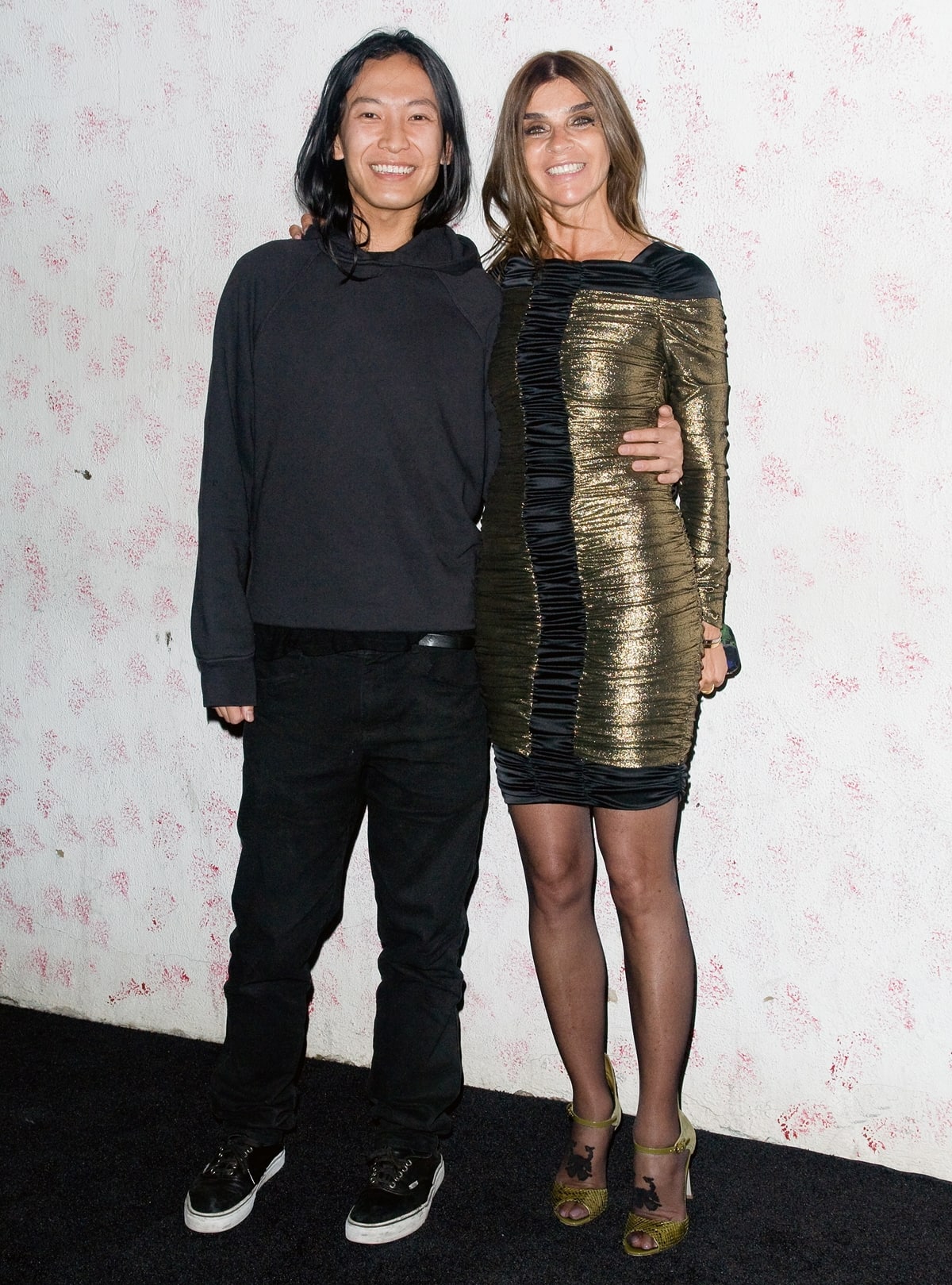 Alexander Wang with Carine Roitfeld at the Barneys New York fête honoring the French fashion editor at The Westway on September 10, 2011, in New York City (Credit: Ivan Nikolov / WENN)
Wang received the CFDA/Vogue Fashion Fund award in 2008, a major milestone in the label’s early expansion. Accessories soon became an increasingly important part of the business, giving the brand recognizable products that could outlast an individual runway season.
The diffusion line T by Alexander Wang expanded the casual side of the business with T-shirts, jersey, knitwear, and other wardrobe basics. Wang opened his first flagship store in New York’s SoHo neighborhood in 2011.
Alexander Wang at Balenciaga: His 2012–2015 Creative Director Years
In December 2012, Alexander Wang was appointed creative director of Balenciaga, succeeding Nicolas Ghesquière. He was responsible for the French house’s women’s and men’s ready-to-wear, accessories, and overall image while continuing to operate his namesake label.
His first Balenciaga runway collection was presented for Fall/Winter 2013. Wang remained at the house until 2015, when Balenciaga and the designer agreed not to renew his contract. His Spring/Summer 2016 collection, presented in Paris in October 2015, was his last for the house.
During the same period, Wang continued expanding his own label. In 2014, he collaborated with Swedish fashion retailer H&M on a collection spanning womenswear, menswear, footwear, and accessories.
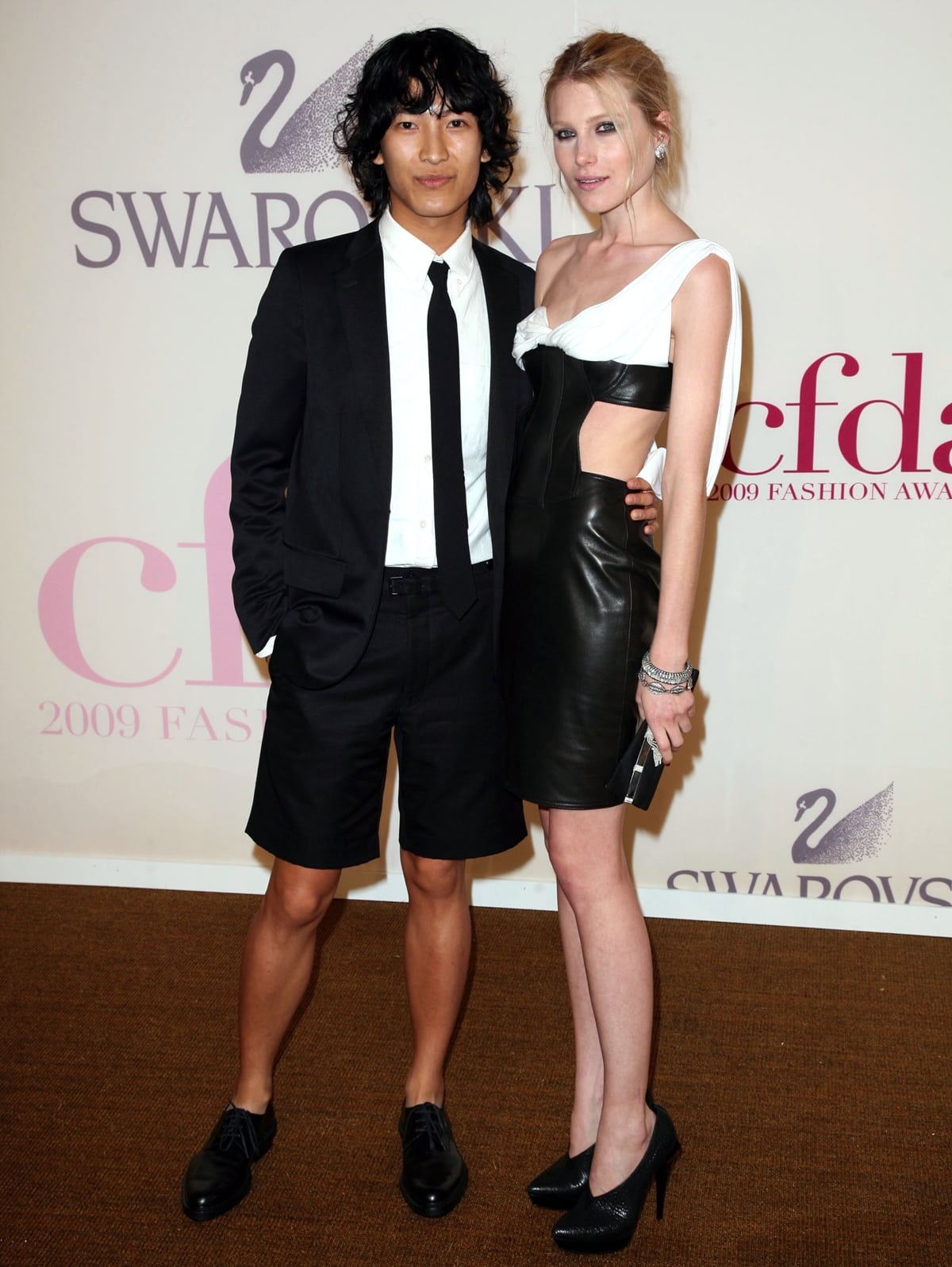 Alexander Wang and model Dree Hemingway at the 2009 CFDA Fashion Awards at Alice Tully Hall on June 15, 2009, in New York City (Credit: Andres Otero / WENN)
Alexander Wang’s Iconic Shoes and Bags: Rocco, Diego, Gabi, Antonia & More
Ready-to-wear established Wang’s aesthetic, but shoes and handbags made it immediately recognizable off the runway. Heavy hardware, black leather, exposed construction, unusual heels, and deliberately practical shapes repeatedly appeared across the brand’s accessories.
Rocco and Diego Bags: The Studded Hardware Signatures
The Rocco and Diego bags became defining Alexander Wang accessories around the turn of the 2010s. Pebbled leather and relatively simple duffle or bucket-like shapes were contrasted with rows of metal studs across the base, giving the bags an industrial detail that was recognizable even when the branding itself was discreet.
👠 Explore More Alexander Wang Shoe & Fashion Moments:
- 🖤 See how Alexander Wang’s strappy Amelia sandals became a celebrity favorite, with the sleek black heels showing the designer’s more minimal approach to evening footwear.
- 👢 Megan Fox gives Alexander Wang’s Dakota boots an off-duty edge, pairing the distinctive lace-up ankle boots with an understated street-style look.
- ✨ Rosie Huntington-Whiteley steps out in sculptural Alexander Wang heels, highlighting the label’s talent for turning architectural details into wearable statement shoes.
- 👜 Revisit the celebrity obsession with Alexander Wang’s studded Rocco bag, one of the accessories that helped define the designer’s downtown aesthetic.
The look translated easily into the celebrity street-style culture surrounding Wang. In 2012, Rihanna paired an Alexander Wang studded bag with the designer’s Cameron mesh-toe boots, putting two sides of the label’s accessories vocabulary into the same off-duty outfit.
Dakota Boots: Wang’s Lace-Up Statement Boot
Wang’s boots became another important part of the label’s identity. The Dakota lace-up bootie combined a substantial heel with a cutout back and laced upper, creating a shoe that was more visually complex than a conventional ankle boot.
Teresa Palmer wore mustard Alexander Wang Dakota booties during a 2011 I Am Number Four photocall in Madrid, while other versions of the style appeared on celebrities during the same period.
Anouck, Kori, and Gabi Boots: The Cutout-Heel Signatures
The Anouck, Kori, and Gabi boots pushed the brand’s hardware language directly into the heel. Cutaway sections and metallic plates made the shoes identifiable from the side and back, turning what is normally a structural part of a boot into its defining design feature.
Kendall Jenner repeatedly wore Alexander Wang Anouck Chelsea boots, including while traveling through Los Angeles International Airport in 2014. The black boots worked particularly well with the leggings, sweaters, denim, and oversized outerwear that defined much of the period’s model-off-duty wardrobe.
For a broader look at how these silhouettes fit into women’s footwear, see our guide to essential boot styles.
Antonia Sandals: Wang’s Minimalist Red-Carpet Heel
Not every recognizable Alexander Wang shoe relied on heavy hardware. The Antonia sandal took the opposite approach, using slender straps and a stiletto heel to create a barely-there silhouette that worked particularly well with eveningwear.
Bella Hadid wore black Alexander Wang Antonia sandals at the 2016 Grammy Awards, pairing them with a black Alexandre Vauthier gown. The shoe’s stripped-back construction kept the focus on the dress while maintaining the monochromatic palette common in much of Wang’s work.
Wang’s experiments with metal inserts, cutouts, platforms, and minimalist stilettos also show how much visual identity can come from the heel itself. Our guide to different types of heels explains the broader heel shapes and constructions used across women’s footwear.
Cora Platform Boots: The Heavier Side of Wang Footwear
The brand has also repeatedly explored platforms and substantial block heels. In 2017, Vanessa Hudgens wore Alexander Wang Cora platform boots with red fishnets and an oversized graphic T-shirt at Knott’s Scary Farm in California.
The Cora’s thick platform and block heel represented a different side of Wang footwear from the Antonia sandal, but both designs relied on strong proportions rather than prominent logos to make the shoe recognizable.
How Alexander Wang Became a Model-Off-Duty Favorite
Alexander Wang’s rise coincided with the growing visibility of models away from the runway. Street-style photography turned airport arrivals, castings, and walks between fashion shows into another fashion platform, and Wang’s clothes and accessories fit that environment particularly well.
The formula was relatively straightforward: distressed or skinny denim, leggings, loose T-shirts, slouchy knits, leather jackets, substantial handbags, and ankle boots. Instead of looking like runway outfits transplanted onto the street, the pieces could be mixed into an everyday wardrobe.
Models including Behati Prinsloo, Anna Ewers, and Binx Walton became closely associated with Wang’s wider creative circle, sometimes described as the “Wang Gang.” That relationship between runway casting, celebrity friendships, parties, and off-duty dressing helped make the brand part of a broader fashion culture rather than simply a collection shown twice a year.
From Runway After-Parties to WangFest: Alexander Wang’s Fashion-Party Era
Wang also became known for treating fashion shows and brand events as part runway presentation and part nightlife experience. After-parties, music, celebrity guests, and surprise performances became recurring parts of the brand’s public identity.
The approach reached an especially literal form with “WangFest,” which framed the fashion event around the atmosphere of a music festival. Musicians and pop-culture figures including M.I.A. also appeared within Wang’s creative orbit.
 Photographer Ryan McGinley, musician M.I.A., and Alexander Wang at the designer’s Spring 2011 show at Pier 94 during New York Fashion Week on September 11, 2010 (Credit: Flashpoint / WENN)
From the CFDA/Vogue Fashion Fund to CFDA Awards: Wang’s Early Industry Recognition
Wang’s early rise came with substantial industry recognition. After receiving the CFDA/Vogue Fashion Fund award in 2008, he won the Swarovski Womenswear Designer of the Year award and the Swiss Textiles Award in 2009.
He received another Swarovski award in the accessories category in 2010 and continued to collect fashion-industry honors as the label expanded internationally.
 Alexander Wang takes the runway at the Alexander Wang x H&M collection launch at the Armory on the Hudson on October 16, 2014, in New York City (Credit: Alberto Reyes / WENN)
Celebrity adoption reinforced that visibility. Wang’s designs have been worn by figures including Kanye West, Kim Kardashian, and other musicians, actors, and models across red carpets and street-style appearances.
The 2020 Allegations and Alexander Wang’s Return to Fashion
In late 2020, model Owen Mooney publicly accused Alexander Wang of sexual misconduct. Additional allegations subsequently circulated through social media and were reported by fashion and mainstream media outlets. Wang initially denied the allegations.
In March 2021, Wang issued a statement saying that he regretted acting in ways that caused others pain and that he would do better. The controversy led to renewed discussion about accountability in the fashion industry and continued to shape coverage of his later return to major fashion events.
Wang subsequently resumed staging collections for his namesake label. In 2022, the company received its first outside investment, with China-based Challenjers Capital and Youngor taking undisclosed minority stakes in the business.
Alexander Wang’s 2025 NYFW Return: The Matriarch and 20 Years of the Brand
In September 2025, Alexander Wang returned to the official New York Fashion Week schedule as the label marked its 20th anniversary.
The runway presentation, titled The Matriarch, centered on Wang’s mother, Ying Wang, and marked a high-profile return to the New York calendar after years of showing outside the traditional NYFW schedule.
Rather than returning to the label’s earliest aesthetic, the anniversary connected the company’s history with its next phase—two decades after Wang first established the business in New York.
Where Are Alexander Wang Shoes, Bags, and Clothes Made?
Although Alexander Wang is an American label headquartered in New York, it has historically manufactured its products across several countries rather than exclusively in the United States.
Reporting on the company’s earlier expansion documented substantial manufacturing in Asia, followed by increased European production as the label moved further into the designer market. European manufacturing has included factories in Italy, Spain, Portugal, and Turkey.
Manufacturing location can vary by product, collection, and year, so the country-of-origin label on an individual garment, shoe, or handbag is more useful than assuming that every Alexander Wang product is made in the same place.
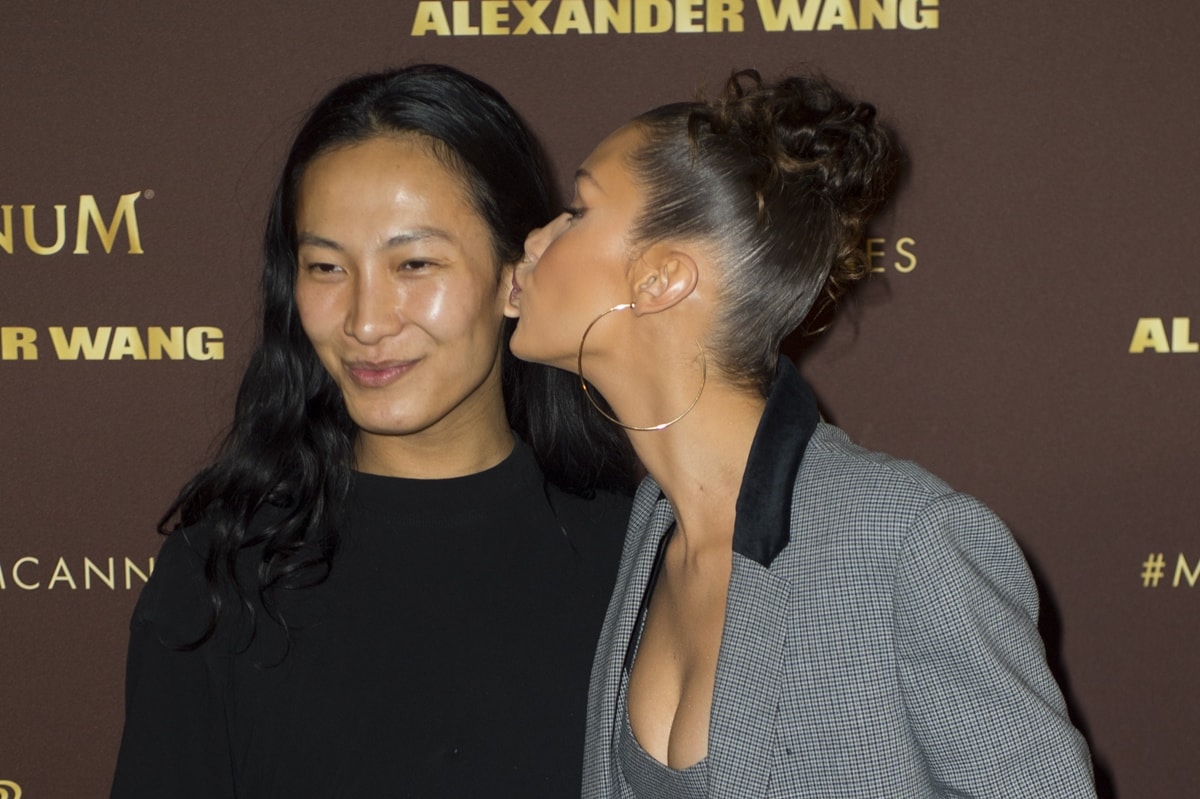 Bella Hadid kisses Alexander Wang on the cheek at the Magnum VIP Party during the 71st Cannes Film Festival on May 10, 2018, in Cannes, France (Credit: Euan Cherry / WENN)
Alexander Wang’s New York Roots: Headquarters, SoHo, and NYFW
Alexander Wang established his business in New York, and the city has remained central to the label’s identity. Its first flagship store opened in SoHo in February 2011, followed by international retail expansion.
The company’s New York roots also remain important to its runway history, from its early fashion-week collections to its return to the official NYFW schedule for the brand’s 20th anniversary in 2025.
Where to Buy Alexander Wang Shoes, Bags, and Archive Styles
The official Alexander Wang website sells the label’s current ready-to-wear, footwear, handbags, and accessories, while selected fashion retailers carry additional styles. Availability varies considerably by season, particularly for older shoe and handbag designs.
That matters for styles such as the Dakota, Anouck, Gabi, Antonia, Rocco, and Rockie, many of which are better understood as archive Alexander Wang designs than as permanent current-season products.
For discontinued shoes and bags, the secondhand market can therefore be particularly useful. Our guide to the best resale sites for pre-owned designer shoes and bags explains how major platforms differ in authentication, condition information, returns, and seller involvement.
When buying older Alexander Wang footwear secondhand, check the photographs for outsole and heel wear, stretched leather, missing hardware, previous repairs, and accurate sizing information. Distinctive construction details can also be useful when comparing an older pair with documented examples of the original design.
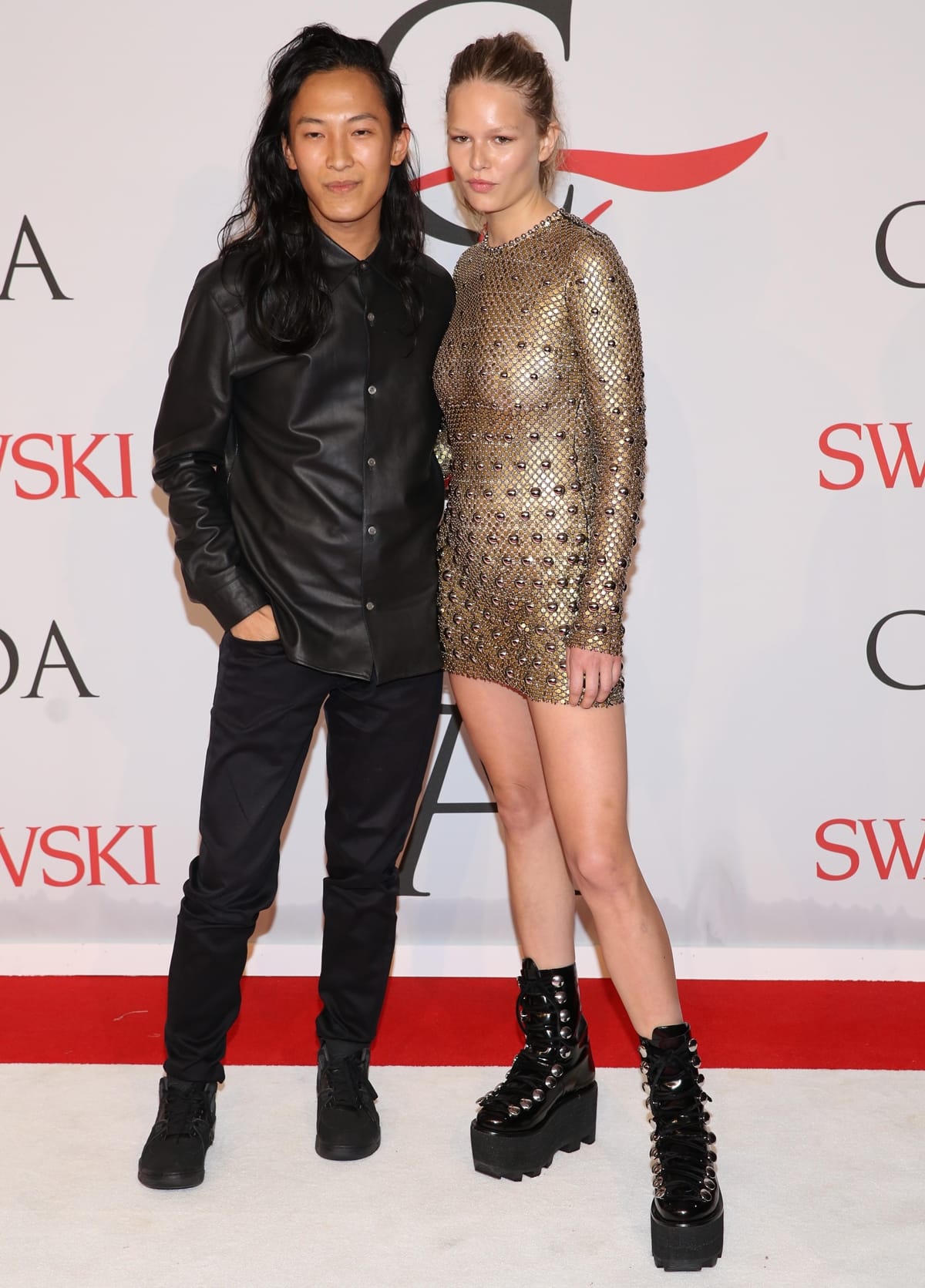 Alexander Wang and model Anna Ewers at the 2015 CFDA Awards at Alice Tully Hall on June 1, 2015, in New York City; Ewers pairs her embellished mini dress with towering black platform boots (Credit: Andres Otero / WENN)
From Rocco Bags to Cutout-Heel Boots: Alexander Wang’s Accessories Legacy
Alexander Wang’s influence is easiest to see in the accessories that translated his runway aesthetic into recognizable everyday objects. The stud-covered Rocco and Diego bags captured the brand’s hardware-heavy side, while the Dakota, Anouck, Kori, and Gabi boots turned heels, cutouts, and metal plates into design signatures of their own.
The Antonia sandal showed the opposite side of the label: minimal, narrow, and deliberately unobtrusive beneath an evening gown. Later platform styles such as the Cora returned to heavier proportions, demonstrating how widely Wang’s footwear could move while retaining the brand’s preference for strong silhouettes.
Together, those designs help explain why Alexander Wang became so closely connected with the model-off-duty wardrobe of the late 2000s and 2010s. The clothes established the attitude, but the boots, heels, and bags often supplied the details that made the look immediately recognizable.