
When you hear the word “sunglasses,” what’s the first brand you think of? There’s a good chance it’s Ray-Ban.
This classic brand has been worn by celebrities such as Rihanna, Lady Gaga, and Hilary Duff and is undoubtedly one of the world’s most renowned eyewear brands.
🕶️ Jump to a Section:
Ray-Ban was launched in 1937 by the Bausch & Lomb company and has produced iconic designs ever since.
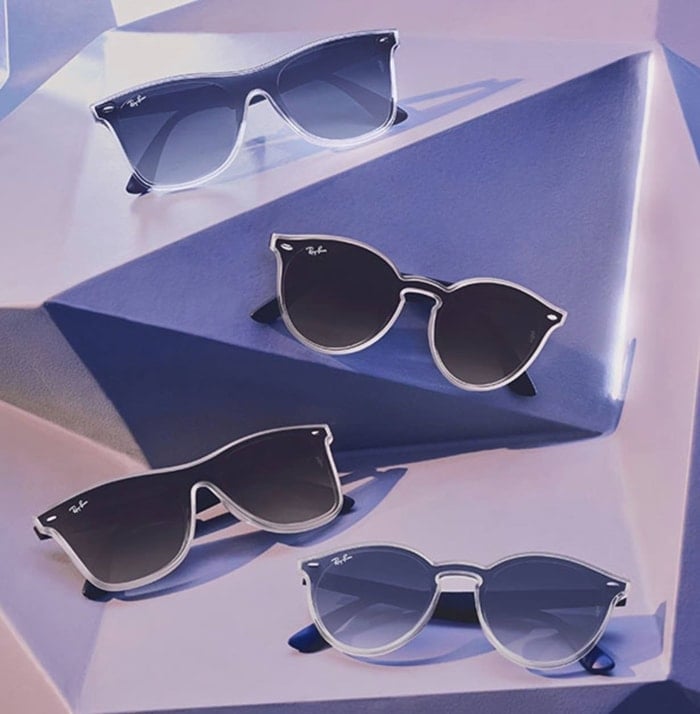 A curated display of authentic Ray-Ban sunglasses highlights the brand’s modern designs, produced in manufacturing facilities worldwide, including in China (Credit: Ray-Ban)
The Italian-American brand is perhaps best known for its Wayfarers and Aviators, which were originally designed to help U.S. Army Air Service pilots perform their duties. Ray-Ban has also been credited with creating wraparound-style sunglasses.
 A glowing Ray-Ban storefront sign highlights the iconic eyewear brand’s legacy, proudly marked “Genuine Since 1937,” inside a modern retail setting (Credit: Robert Way / Shutterstock)
Because Ray-Ban offers everything from classic styles to contemporary designs — and all in various colors — there’s a pair of Ray-Bans to complement your lifestyle and personality.
No wonder the brand remains a leading choice in eyewear for everyone from celebrities to street style stars.
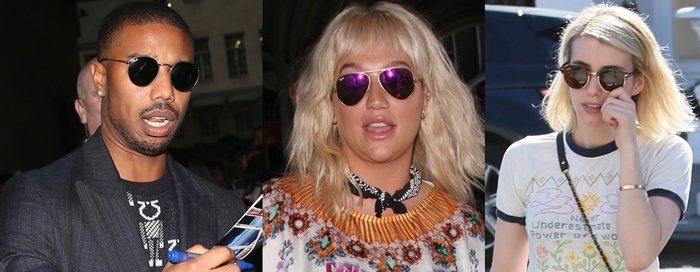 Michael B. Jordan, Kesha, and Emma Roberts each put their own spin on Ray-Ban sunglasses, showcasing the brand’s versatility across red-carpet appearances and casual street style (Credit: Michael Wright / WENN / Avalon)
KTAL-TV reported in April 2019 that a slew of counterfeit Ray-Bans worth more than $40,000 was seized by U.S. Customs and Border Protection officers in Shreveport, Louisiana.
In May 2022, ClickOnDetroit reported that police in Detroit had confiscated thousands of Louis Vuitton, Gucci, Versace, Chanel, Coach, Armani, MCM, Ferragamo, and Ray-Ban products.
ABC7 News reported on scammers creating copycat sites that look like legitimate fashion sites later that same year. These sites often steal photos from Ray-Ban’s official website to scam customers.
However, there’s no need to worry about counterfeits if you do your due diligence when buying your Ray-Bans. It’s easy enough to separate the knock-offs from the real deal.
Where to Buy Authentic Ray-Ban Sunglasses (And Avoid Costly Fakes)
To avoid counterfeit products, always purchase Ray-Ban sunglasses from authorized and reputable retailers. Buying from trusted sellers helps ensure authenticity, valid warranties, and reliable customer support.
- Ray-Ban (Official Website) — The safest option, offering the full range of styles, colors, and lens customizations.
- Shopbop — A fashion-forward retailer known for carrying authentic designer accessories.
- Farfetch — A global luxury marketplace with verified boutique partners.
- Nordstrom — A long-standing department store with strong authenticity controls.
- Zappos — A reliable option with easy returns and verified inventory.
Since it’s getting harder and harder to distinguish the replicas from the real ones, here are some of our top tips on how to authenticate a pair of Ray-Bans:
Why Ray-Bans Cost More Than Knockoffs (And What You’re Paying For)
Ray-Bans average about $150 a pair. If the price on a pair of Ray-Ban sunglasses seems too good to be true, you have every reason to be suspicious.
That’s why we recommend buying only from authorized retailers, such as those listed above.
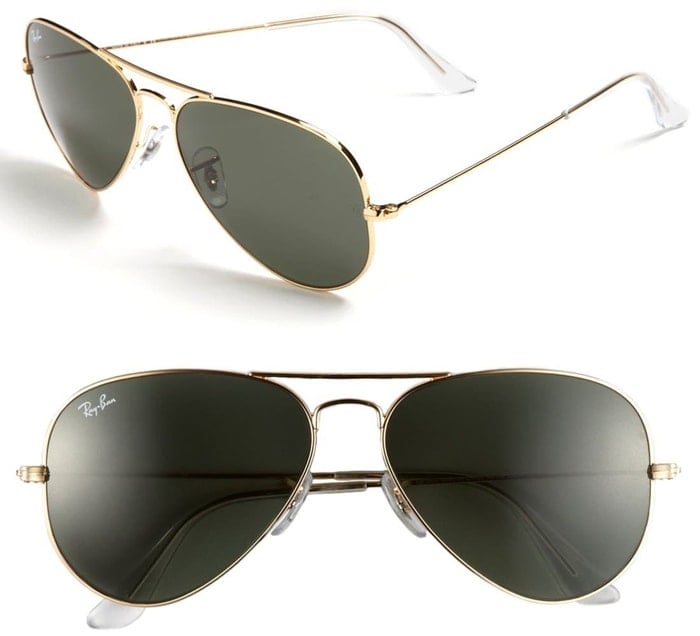 Classic Ray-Ban aviator sunglasses make a timeless and sophisticated style statement, while adjustable nose pads ensure custom comfort (Credit: Ray-Ban)
If the $150 price point seems a little steep, look for flash sales and promotions at off-price department store chains such as Nordstrom Rack to get great deals while still ensuring the product’s authenticity.
In an interview with CNN, Ray-Ban’s global brand director, Sara Beneventi, said the brand’s sunglasses are more expensive than knockoffs because they’re more expensive to produce. “We don’t have plastic lenses,” she emphasized.
How to Spot a Genuine Ray-Ban Logo on the Lens
Examining the logo placement on the lens is a reliable way to verify the authenticity of Ray-Ban sunglasses, though it’s not foolproof.
Many counterfeit Ray-Bans may have a logo on the left lens or a poorly etched logo that is not precise.
Authentic Ray-Bans typically feature a finely etched logo in the upper corner of the right lens for most models, such as Aviators and Wayfarers. However, depending on the style or production year, some genuine Ray-Ban models may not have a lens logo.
To confirm authenticity, also check the logo’s quality, font, and clarity, and verify other markers like the “RB” or “BL” etching on the lens (pre-2000 models may have “BL”).
In addition to placement, the logo should be finely etched into the lens rather than printed or painted on. On polarized styles, authentic Ray-Ban lenses may also feature a subtle “Ray-Ban P” marking, while fake versions often use decals that can scratch or peel.
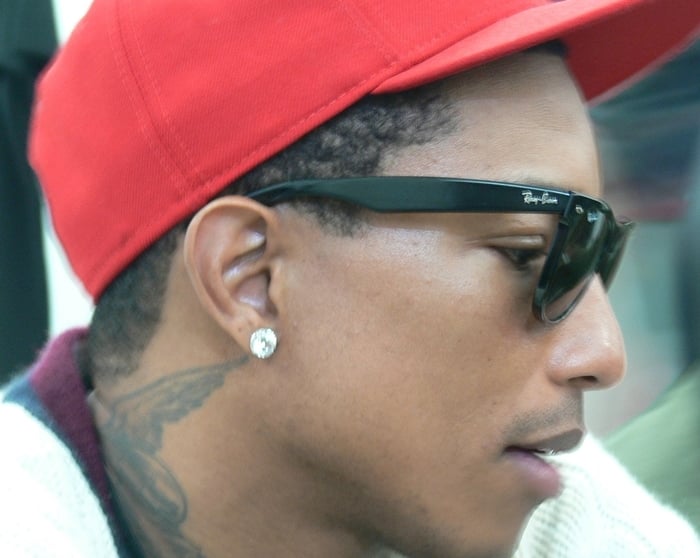 Pharrell Williams wears genuine Ray-Ban sunglasses with unmistakable frames featuring the engraved logo (Credit: Michael Wright / WENN / Avalon)
Ray-Ban sunglasses are known for their high quality, so if the pair’s logo is flaking or peeling, there’s a good chance the sunglasses are fake.
The Gold Lens Sticker Explained: Real vs Fake Ray-Bans
All new Ray-Ban sunglasses feature a gold sticker on the lens that includes the Ray-Ban logo and a black font. The sticker should also state that the glasses have 100% UV Protection.
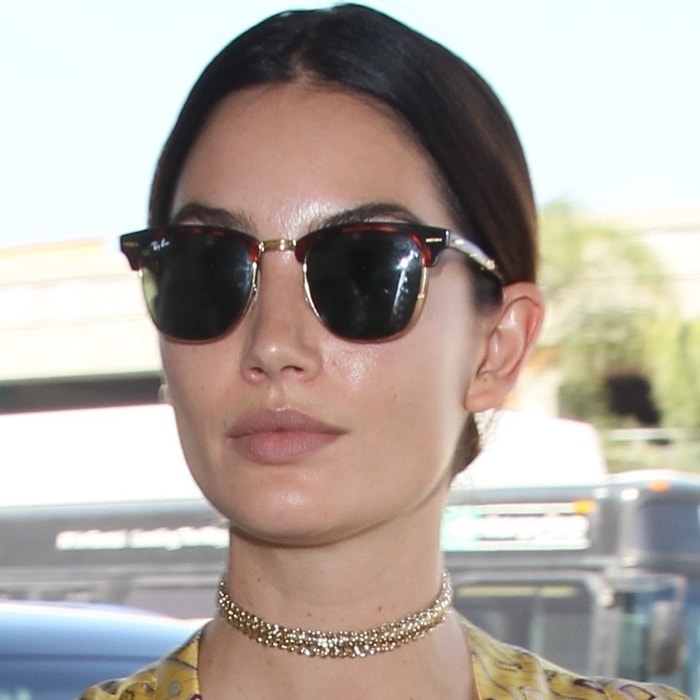 A model showcases retro-inspired Ray-Ban Clubmaster Classic sunglasses, underscoring the enduring appeal of the brand’s timeless browline design (Credit: Michael Wright / WENN / Avalon)
If the sticker is yellow instead of gold and contains misspelled text without a 100% UV Protection guarantee, it is affixed to counterfeit Ray-Ban sunglasses.
There should also be an “RB” etching on the left lens area, however, products made before 2000 will have “BL” engraved instead.
Authentic Ray-Ban Packaging: What Should Be Inside the Box
Each pair of authentic Ray-Ban sunglasses should come in a branded Ray-Ban box that contains a Ray-Ban cleaning cloth, a manufacturer’s note, a mini brochure explaining the product details, a Ray-Ban case, a tag, a manual titled “The Icons,” and the product’s warranty.
If the packaging is incomplete or the product details are misspelled or contain typos, the product is fake. Ray-Ban sunglasses should also be available in a black faux-leather case with a gold logo, or a tan faux-leather case with a black logo.
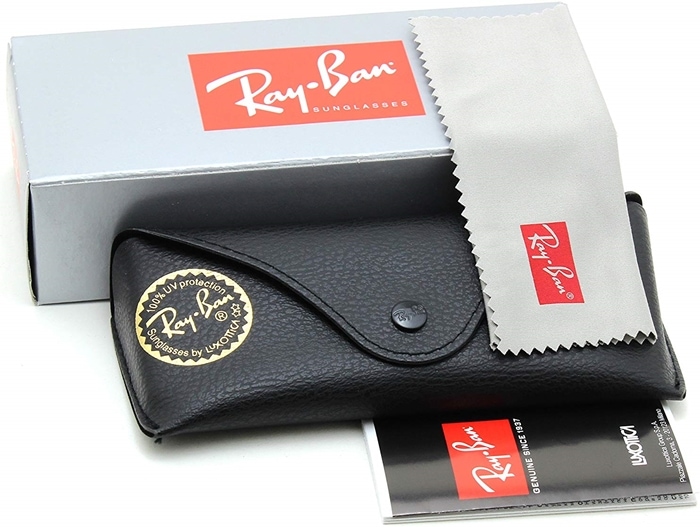 Authentic Ray-Ban sunglasses are packaged with a branded protective case, microfiber cleaning cloth, and official documentation, all key indicators of a genuine pair (Credit: Ray-Ban)
If the case appears to be made of low-quality material or comes in multiple colors, it is most likely not an authentic item.
You should also ensure that the silver cardboard Ray-Ban box containing all these items has a barcode, and inspect the cleaning cloth to confirm it’s soft microfiber and features the Ray-Ban logo.
Authentic packaging also includes a neatly printed informational booklet; low-quality printing or missing inserts can be a red flag.
Model Numbers, Serial Codes & Temple Markings to Check
Each pair of Ray-Ban sunglasses is printed with a serial number and model number, located on the left temple.
The model number is comprised of the letters “RB” followed by four digits. These numbers determine the lens size and the product’s color code. The right temple area should also have an engraving of the Ray-Ban logo.
You may also find CE or UKCA markings on the inner arm, indicating compliance with European and UK safety standards—details often missing or poorly printed on counterfeit pairs.
Why They’re Called Ray-Bans: The Military Origins Behind the Name
As Business Insider explains, you can thank the U.S. military for the world’s most famous sunglasses.
Ray-Bans were first conceived in the 1930s, when U.S. Army Air Corps Lieutenant General John Macready complained about the glare after returning from a test flight.
He contacted Bausch & Lomb, co-founded by optician John Bausch in 1853, to develop a pair of stylish sunglasses that would protect his eyes.
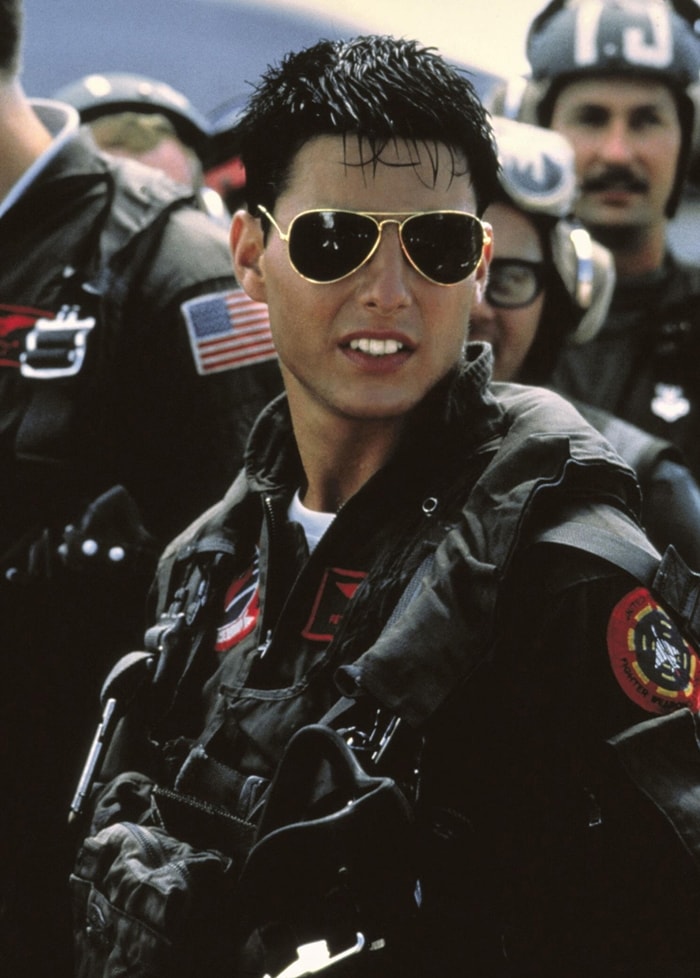 Tom Cruise cements Ray-Ban Aviator Classic (model 3025) as a pop-culture icon, wearing the gold-framed, green-lens sunglasses as U.S. Navy pilot LT Pete “Maverick” Mitchell in Tony Scott’s 1986 action classic Top Gun (Credit: Paramount Pictures)
John, who was one of the Army’s best pilots in the years after World War I, soon received a prototype of his new sunglasses. The prototype was designed with green lenses to remove glare without obscuring the pilot’s vision.
The new anti-glare sunglasses “banned” the distracting ultraviolet and infrared rays from U.S. aviators’ eyes, giving way to the name “Ray-Ban.”
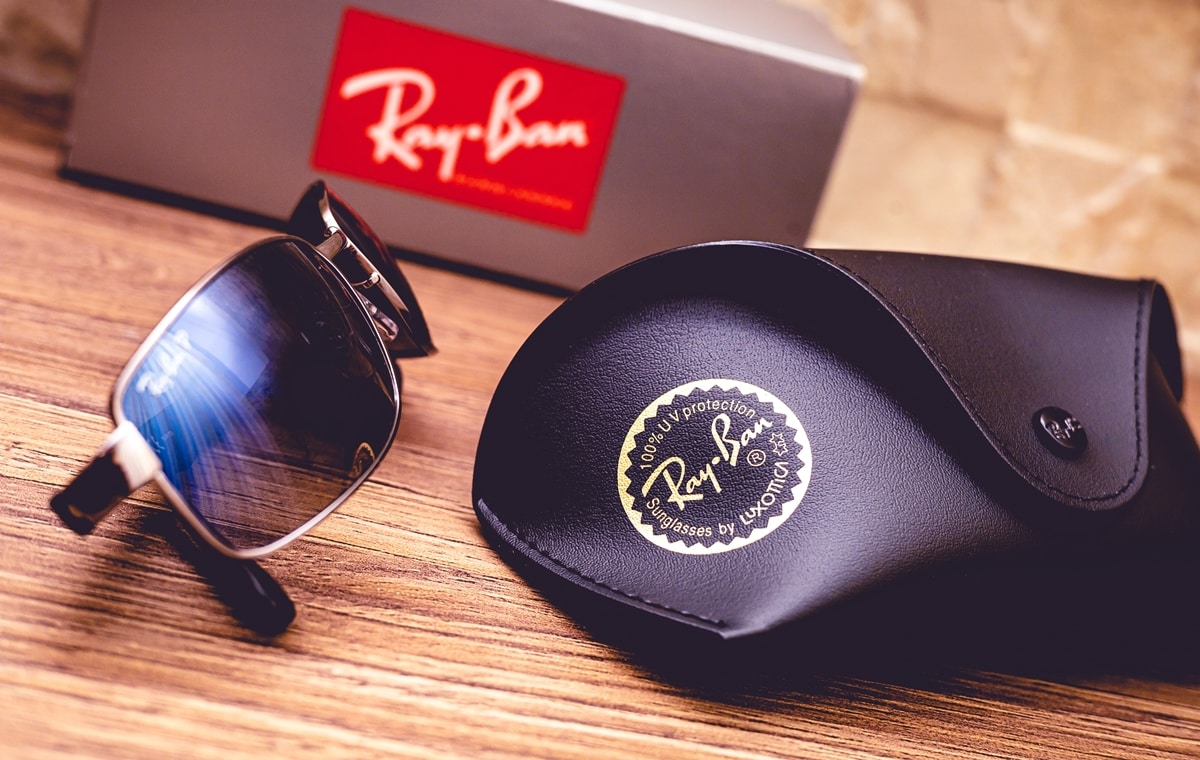 A pair of Ray-Ban sunglasses is displayed alongside the brand’s signature protective case and packaging box, highlighting the premium accessories that accompany an authentic purchase (Credit: Rafastockbr / Shutterstock)
Ray-Ban gradually improved its original lenses by adding a gradient effect during World War II.
General Douglas MacArthur popularized the glasses after photographs were published showing him landing on a beach in the Philippines wearing Ray-Bans in 1944.
Tom Cruise helped make the Ray-Ban Aviator Classic sunglasses famous when he wore them in the 1986 American action drama film Top Gun and its 2022 sequel, Top Gun: Maverick.
Where Ray-Bans Are Made Today (Italy, China & Beyond)
Bausch & Lomb eventually sold Ray-Ban to Italian eyewear conglomerate Luxottica in 1999. The Italian eyewear conglomerate also owns Oliver Peoples, Persol, Alain Mikli, and Oakley.
 Owned by Italian eyewear company Luxottica, Ray-Ban sunglasses are made in a number of countries, including Italy and China (Credit: Marcovaldo / Shutterstock)
Now, Ray-Bans are manufactured in factories worldwide, including in China. Luxottica’s Chinese manufacturing facilities are located in Dongguan, Guangdong.
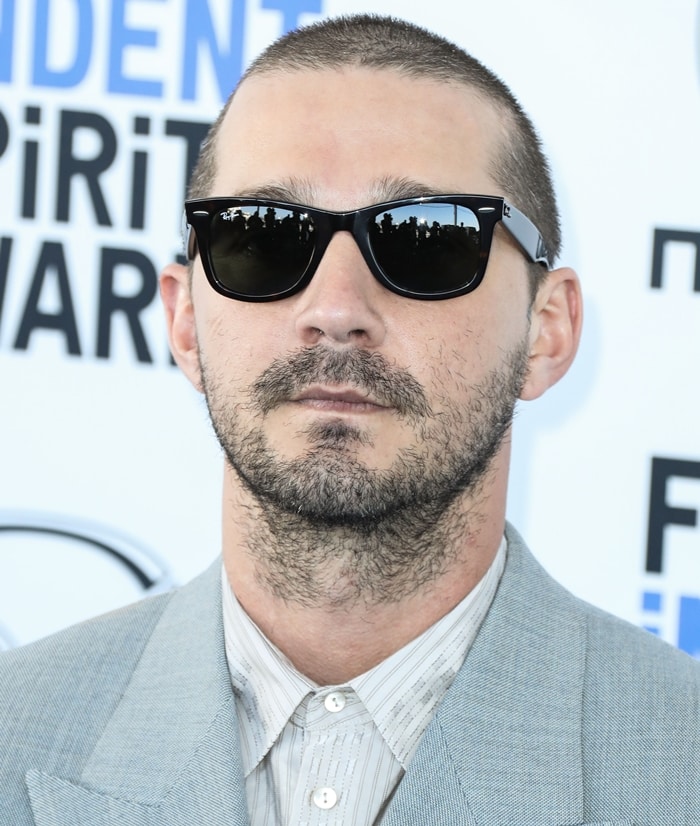 Actor Shia LaBeouf pairs sleek black Ray-Ban sunglasses with a tailored Gucci suit, delivering a sharp, minimalist red-carpet look (Credit: Michael Wright / WENN / Avalon)
Ray-Ban also operates design and development facilities in the U.S., Italy, and Brazil. Luxottica operates two small manufacturing plants in Japan and India, as well as a plant in China.
How Ray-Ban Sunglasses Complete Celebrity Shoe Moments
From off-duty sneakers to polished pumps, Ray-Ban sunglasses consistently show up as the finishing touch in celebrity outfits where footwear does the heavy lifting.
Whether paired with Adidas trainers, Gucci Gazelles, or minimalist heels, the brand’s iconic frames help anchor these looks, proving that great shoes and timeless sunglasses often go hand in hand.
🕶️ Celebrity Fashion Moments Featuring Ray-Ban & Footwear:
- 👟 Olivia Wilde’s Adidas x Gucci Gazelle Sneakers with Ray-Ban Mega Wayfarer Sunglasses — Casual off-duty styling anchored by sneakers and classic Ray-Bans.
- 🏃 Olivia Wilde’s Gym Shoe Rotation & Ray-Ban Wayfarers — Athleisure outfit pairing training shoes with Ray-Ban sunnies.
- 👟 Olivia Wilde Completes Adidas x Gucci Gym Style with Ray-Ban Wayfarers — A real-world celeb look linking footwear and sunglasses.
- ✈️ Emma Stone’s Airport Look with Adidas Superstars and Ray-Ban Sunnies — A classic street-style moment pairing sneakers and Ray-Bans.
- 🥾 Rihanna’s Street Style with Timberland Boots & Ray-Ban Wayfarers — Iconic off-duty footwear styled with Ray-Ban shades.
- 👢 Rachel Bilson’s Sunglasses & Footwear Style — Casual styling featuring Ray-Ban folding Wayfarers and ankle boots.
- 👟 Jennifer Lawrence’s Outfit with Ray-Ban “Lady Burbank” Sunglasses — A polished look pairing Ray-Bans with minimalist pumps.